Streamlining Credentialing for ABA Providers: A Comprehensive Guide
Credentialing an ABA provider means proving that each BCBA, BCaBA or RBT is qualified, then enrolling that provider with every payer the practice bills. The steps run in order: confirm BACB certification and any state license, get NPIs, complete CAQH ProView, apply to each payer, sign the contract, and confirm the effective date.
The same steps apply to a new hire, a new payer or a new location. Each one has a document trail, a deadline and a renewal date. For what happens to claims when a step slips, see how credentialing gaps become revenue-cycle problems.
What does credentialing mean for an ABA practice?
Credentialing is how a payer verifies a provider's qualifications before admitting that provider to its network. Enrollment is the related step that lets the practice bill that payer for the provider's services. Most practices run the two as one project, because a payer will not pay for a provider until both are done.
An NPI is not the same thing. The CMS NPI fact sheet states that having an NPI does not ensure a provider is credentialed. Nor does an NPI enroll a provider in a health plan or guarantee payment. Health plans still require NPIs in their transactions, so the NPI is the first number every application asks for.
Which credentials do BCBAs and RBTs need before you apply?
BCBAs and RBTs each need an active certification from the Behavior Analyst Certification Board (BACB), and the requirements behind each are different. Payers verify these credentials, so confirm them yourself before an application goes out. Many states also license behavior analysts, and the BACB tells certificants to learn the licensure rules where they practice.
The BCBA Handbook lists what a BCBA needs:
- a master's degree or higher, from an accredited behavior analysis program or with qualifying behavior-analytic coursework
- supervised fieldwork in applied behavior analysis: 2,000 hours, or 1,500 hours of concentrated supervised fieldwork
- a passing score on the BCBA certification examination
The BACB has announced revised BCBA requirements from January 1, 2027, including the end of eligibility pathways 3 and 4. Check its recent and upcoming changes before you plan around a candidate's timeline.
The RBT Handbook sets the technician requirements. An RBT applicant must:
- be at least 18 years old and have at least a high school education
- pass a criminal background check and an abuse registry check within 180 days of applying
- complete a 40-hour training over no fewer than 5 and no more than 180 days
- complete the Initial Competency Assessment, then pass the RBT examination
RBTs also need ongoing supervision for at least 5% of their service hours each calendar month. The handbook requires at least two face-to-face, real-time contacts a month, with the supervisor observing service delivery at least once. RBT Supervisors must hold BCBA or BCaBA certification. For how supervision connects to scheduling and authorizations, see ABA modalities, authorization tracking and supervision.
What are the steps to credential an ABA provider with a payer?
The steps are the same for most payers: assemble the file, get identifiers, complete CAQH, apply, sign and confirm the effective date. Payer forms differ, but the order rarely does.
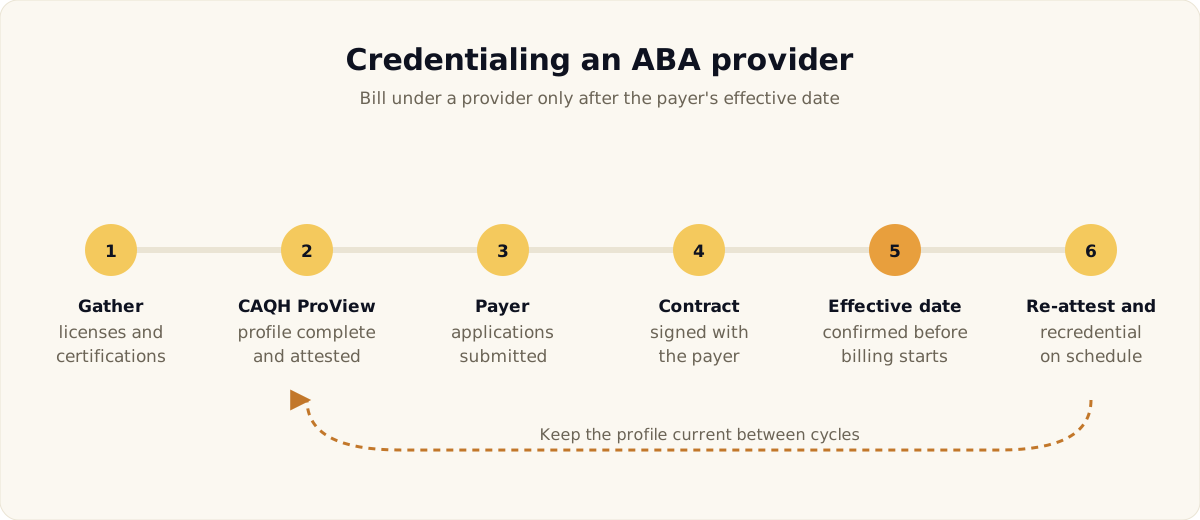
Gather the documents
Collect everything once and keep it in one place. Accurate, consistent documents prevent back-and-forth with payers later.
- each provider's BACB certification and state license where required
- each provider's diploma and proof of malpractice or liability insurance
- the practice's Employer Identification Number (EIN), business registration and a voided check for direct deposit
- Type 1 NPIs for providers and the Type 2 NPI for the organization
Get the right NPIs
CMS issues Type 1 NPIs to individual providers and Type 2 NPIs to organizations such as group practices. Apply online through NPPES, the CMS enumeration system. An incorporated individual provider can hold both types, one for the person and one for the corporation or LLC. Covered providers must report changes to their NPI information within 30 days.
Complete CAQH ProView
CAQH ProView is the shared profile that many health plans read during credentialing. CAQH now operates as DataSpring and calls the tool its Provider Data Portal, which is free to practitioners. Authorize each plan you are applying to, upload supporting documents and attest. The DataSpring practitioner quick reference guide requires re-attestation at least every 120 days, or every 180 days in Illinois.
Apply to each payer
Submit each payer's own application, whether a commercial plan, a state Medicaid agency or a Medicaid managed care plan. Federal rules at 42 CFR 438.602 require states to screen and enroll the network providers of Medicaid managed care plans. The Medicaid Provider Enrollment Compendium explains that requirement. A managed care network can therefore involve both state enrollment and plan credentialing. Payers then verify credentials with primary sources such as the BACB and state boards.
Sign the contract and confirm the effective date
Approval arrives as a contract or welcome letter with an effective date. Get that date in writing, because it marks the first date of service the payer has agreed to pay. Services before it are a separate question that each payer answers its own way.
Enroll with your clearinghouse
To send claims and receive electronic remittances, a practice usually also enrolls with each payer through its clearinghouse. The step is easy to overlook and can hold up first claims.
How long does credentialing take?
No single timeline applies, because each payer sets its own processing time. Ask each payer for its current turnaround when you submit, and log the answer with the application. Start applications as soon as an offer is accepted, not on the provider's first day. Missing or inconsistent details can send an application back, so check CAQH, NPPES and the application against each other first.
Do RBTs need their own payer enrollment?
RBT enrollment depends on the payer and the state. Some payers require an individual NPI or enrollment for each RBT. Others bill RBT services under the supervising BCBA. Ask every payer for its written policy, and record which model applies to which plan.
How do you keep credentials current after approval?
Credentials stay current through one renewal calendar that covers the BACB, CAQH, every payer and NPPES. A lapse in any one of them can stop payment. Track these dates for every provider:
- BCBA recertification every two years, with 32 CEUs, including 4 in ethics and 3 in supervision for supervisors
- RBT recertification, which moves to a two-year cycle with 12 hours of professional development after a final annual renewal in 2026
- CAQH re-attestation every 120 days
- payer recredentialing, which NCQA requires every three years for the organizations it accredits
- Medicaid revalidation, which states must complete at least every five years
- NPPES updates within 30 days of a change
Staff turnover adds steady work. Each new BCBA or RBT starts the cycle again, so build an onboarding checklist that begins with the payer list. Our companion piece on credentialing and revenue cycle management shows how each lapse turns into a denial and how to catch it early.
Where does Lumenality fit?
Lumenality, an EHR built only for ABA, keeps provider credentials in the same system as scheduling, session notes, authorizations, billing and claims. Your team has one reference point when a CAQH update or payer application arrives. Nobody has to hunt through scattered files and spreadsheets.
Credentials do not stand still after approval, so the related tools sit alongside them:
- CEU tracking for BCBAs and BCaBAs
- fieldwork accumulation for trainees working toward BACB certification
- RBT supervision hours and supervision ratios, with BCBA co-sign workflows
- a video training library for staff onboarding
Stedi, the clearinghouse built into Lumenality, carries claims, claim status checks and remittance posting. Clearinghouse enrollment is handled with the practice. Read more about why we built on Stedi.
Credentialing files hold sensitive personal data, so security matters. Every practice gets a dedicated single-tenant deployment with its own database and encryption keys. Data is encrypted with AES-256 at rest and TLS 1.2+ in transit, with role-based access control and an audit trail of record access. For more on that model, see single-tenant security for ABA practices.
Your practice, simplified
Credentialing does not have to live in spreadsheets. If you'd like to see credentialing, supervision and billing together for an ABA practice, request a demo whenever you're ready.
*This article was created with AI assistance and reviewed by the Lumenality team.*