Streamlining Credentialing & RCM for ABA Practices
Credentialing gaps become revenue-cycle problems because payers do not pay for a provider they have not enrolled for that date of service. The session happens, the claim goes out, and the remittance comes back denied. Prevent it by tracking enrollment status, effective dates and renewal deadlines for every provider and payer pair.
Credentialing denials usually start long before the claim, at hiring or scheduling. The fix therefore belongs in credentialing, not in the billing queue. For the full credentialing process step by step, start with our comprehensive credentialing guide.
Why does a credentialing gap show up as a claim denial?
A credentialing gap shows up as a denial because the claim names the provider, and the payer checks that provider against its enrollment records. Health plans require NPIs in their transactions, according to the CMS NPI fact sheet. The same fact sheet notes that an NPI alone does not enroll a provider or guarantee payment. When the rendering provider is not enrolled for that date, the payer denies the line.
The 835 remittance explains the denial through claim adjustment reason codes (CARCs). Two published X12 claim adjustment reason codes point straight at credentialing:
- 185: "The rendering provider is not eligible to perform the service billed."
- B7: "This provider was not certified/eligible to be paid for this procedure/service on this date of service."
Reading these codes correctly matters. A biller who treats them as data-entry errors may correct and resubmit, only to see the claim deny again. Route them to whoever owns credentialing instead.
Where do credentialing gaps come from?
Credentialing gaps tend to follow three patterns: billing before enrollment, billing before the effective date, and renewals that lapse. Each pattern has a different fix.
Claims for a provider who is not yet enrolled
A new BCBA starts seeing clients while a payer application is still pending. Sessions billed to that payer under the new BCBA's NPI will deny until enrollment is complete. Swapping in an enrolled colleague's NPI is not a fix. Follow each payer's written policy on who may be listed as the rendering provider, and schedule around it.
RBTs need the same attention. Some payers enroll RBTs individually, while others bill RBT services under the supervising BCBA. Under the second model, a supervising BCBA who is not enrolled with that payer can put every RBT claim beneath them at risk.
Sessions before the effective date
Payer approval comes with an effective date, and that date matters more than the approval date. Whether a payer will pay for services before the effective date is the payer's decision. For Medicaid, the Medicaid Provider Enrollment Compendium says each state should keep a documented policy on whether to approve a retroactive billing date. Do not assume backdating; get the effective date in writing.
Holding claims while you wait carries its own risk. Each payer sets a timely filing limit, and a late claim can come back with CARC 29: "The time limit for filing has expired." Record each payer's limit next to the pending application, so held claims go out in time.
Recredentialing and recertification lapses
Credentials expire on their own schedules, and a lapse in any one of them can stop payment. Watch these deadlines:
- BACB recertification. A BCBA who misses the recertification date becomes inactive and may not bill, practice or supervise as a BCBA, according to the BCBA Handbook. A 30-day reinstatement period follows before the certification expires.
- RBT recertification. The RBT Handbook moves RBTs from annual renewal to a two-year cycle with 12 hours of professional development.
- CAQH ProView. Practitioners must re-attest at least every 120 days, or every 180 days in Illinois, per the DataSpring practitioner guide.
- Payer recredentialing. NCQA standards call for recredentialing every three years.
- Medicaid revalidation. States must revalidate every provider at least every five years. The compendium adds that providers who miss the revalidation due date should not be paid for the gap.
Practice changes count too. Covered providers must report changes to their NPI information within 30 days. CMS notes that an NPPES update does not automatically update a Medicare enrollment record. Report each change to every payer separately as well.
How do you stop credentialing gaps from becoming denials?
You stop them by checking credentials before the session, not after the remittance. A short routine covers most cases:
- Keep one roster of every provider and payer pair, with application status, effective date, recredentialing date and CAQH attestation date.
- Before a provider's first session with a client, confirm that provider is enrolled with the client's payer as of that date.
- Run an eligibility check (270/271) before the first visit, so the client's coverage is settled too.
- Start renewals early, with BACB, CAQH, payer and Medicaid dates on one shared calendar.
- Review every 835 for codes 185 and B7, and send those denials to credentialing.
- When a gap turns up, fix the provider record first, then correct and resubmit the claim.
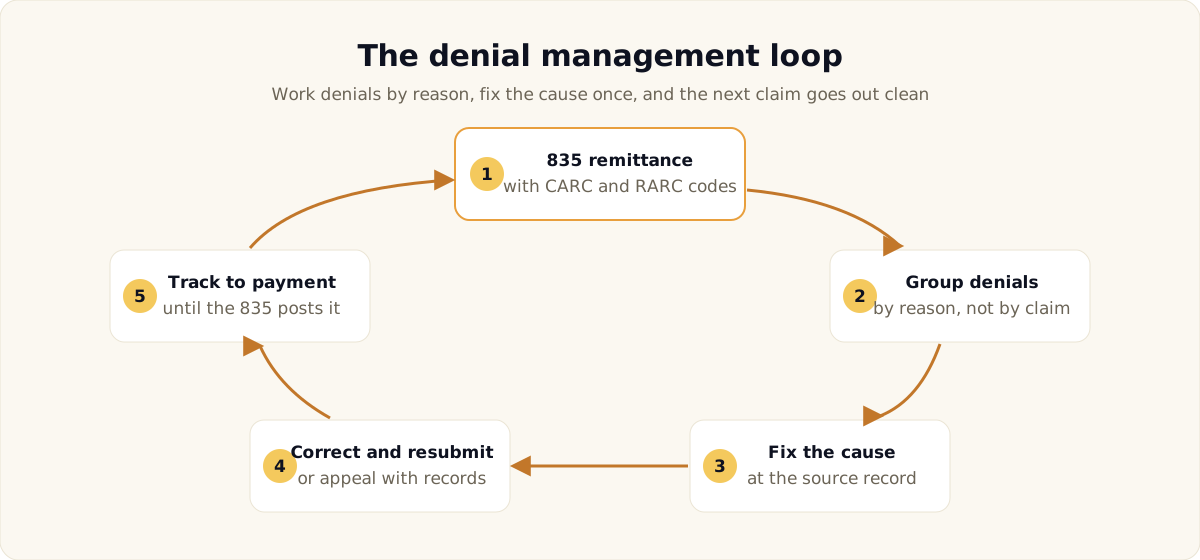
Credentialing denials follow the same loop as any other denial: group them by reason, fix the cause at the source, then correct and resubmit. Our guide to denial management for ABA billing covers the whole loop. Authorizations need the same discipline, as mastering prior authorizations explains.
How Lumenality supports credentialing and billing
Lumenality is an EHR and practice-management platform built for ABA practices. Provider credentials sit in the same system as scheduling, session notes, authorizations, billing and claims. Credential management, CEU tracking and fieldwork accumulation live there too. RBT supervision hours and supervision ratios are tracked, and BCBA co-sign workflows keep oversight documented.
The session note and its data become the claim line, so the CPT code, units and authorization come from the same record. Rule-based checks run before the claim goes out and assign a denial-risk score. A blocking issue stops the claim, and a warning flags it for review.
Stedi is the clearinghouse built into Lumenality, and enrollment is handled with the practice:
- 837P claims, with 999 and 277CA acknowledgments tracked per claim
- 835 remittances that post payments automatically
- real-time eligibility (270/271) and claim status (276/277) checks
Read more about why we built on Stedi.
Authorizations draw down by CPT code per session, with a warning at 80% of units used. Authorizations about to expire are flagged before the dates lapse. For Medicaid programs that require Electronic Visit Verification (EVV), visits are captured when the note is signed. Exceptions go to a review queue, and a claim gate holds back claims with unresolved exceptions.
Every practice gets a dedicated single-tenant deployment with its own database and encryption keys. Role-based access control, MFA, an audit trail of record access and a signed BAA come standard. Executive dashboards for revenue, utilization and payer mix give leadership a clear financial picture. See the full feature set on our ABA EHR page, or read how billing works in optimizing ABA billing in Lumenality.
Focus on care, not paperwork
Credentialing and billing work best as one process, run from one record. If you'd like to walk through your credentialing and billing workflows with us, request a demo whenever you're ready.
*This article was created with AI assistance and reviewed by the Lumenality team.*