Showcasing Customization: Tailored EHR for Specialized ABA Therapy Needs
A tailored ABA EHR fits four workflows without custom development: data collection, treatment plans and BIPs, RBT supervision, and authorizations by CPT code. Settings should handle your targets, templates and payer rules. If any of the four needs a paid project, the system was not built for ABA. Customization should mean configuration, not code.
Lumenality is an EHR and practice-management platform built only for ABA. Every practice runs in its own single-tenant environment, with a dedicated deployment and its own database. The goal is an EHR that supports your clinical process rather than dictating it. The sections below show what each of the four workflows should look like on day one.
Why do generic EHRs fall short for ABA?
Generic EHRs fall short because ABA documentation is measurement, not narrative. A typical visit note records what happened. An ABA session records how often, how long and how accurately a behavior occurred, target by target. Systems built for a broad medical audience lack fields for trial data, supervision ratios and authorization units. Staff then rebuild that work in spreadsheets, and every workaround is a place where a session and its claim can drift apart.
Which data collection methods should an ABA EHR support?
An ABA EHR should support trial-by-trial, frequency, duration and interval recording without a setup project. Measurement is a core domain of behavior analysis. The BCBA Test Content Outline (6th ed.) asks candidates to distinguish continuous from discontinuous measurement. It also covers applying interval recording and time sampling. A system that records only one kind of data forces clinicians to use the method the software allows, not the one the behavior needs.
In Lumenality, data collection covers the methods clinicians use every day:
- On mobile: RBTs record trial-by-trial, frequency, duration and interval data on electronic data sheets.
- Agreement checks: inter-observer agreement (IOA) can be recorded alongside session data.
- Graphs: automated graphing and trend analysis turn each session into a visible progress line.
- Programs: a program library holds reusable targets, and preference assessments support reinforcer identification.
- PECS: a board builder and phase tracking keep picture-exchange work in the same record.
Data volume matters as much as data type on a large caseload. Our post on high-volume ABA data in a single-tenant EHR covers that side.
How should treatment plans and BIPs connect to session data?
Treatment plans and BIPs should draw on the same record as the sessions that carry them out. An FBA identifies why a behavior occurs, the BIP sets the procedures, and the treatment plan sets measurable goals. When session data feeds those goals directly, progress reports fill in from the data instead of being rebuilt by hand. Copying graphs into a report template is a sign the system is not connected.
Lumenality supports FBAs, BIPs and treatment plans with measurable goals and objectives. Progress reports auto-populate from session data. Clinicians can write ABA session notes or use SOAP, DAP and narrative templates. Detailed records matter for demonstrating medical necessity, tracking incremental progress and meeting payer requirements.
What should RBT supervision tracking cover?
Supervision tracking should cover hours, contacts, ratios and sign-offs, because the BACB sets monthly minimums. The BACB RBT Handbook requires supervision for at least 5% of an RBT's service hours each calendar month. It also requires at least two face-to-face, real-time contacts a month. The supervisor must observe the RBT providing services in at least one of them.
Counting those hours by hand at month end is where supervision gaps start. Lumenality tracks supervision hours, tracks and enforces RBT supervision ratios, and supports BCBA co-sign workflows. Credential management, CEU tracking and fieldwork hour accumulation sit in the same system. Our post on ABA modalities, authorization tracking and supervision goes deeper on the daily routine.
How should an ABA EHR track authorizations?
Authorizations should draw down by CPT code with every session, so nobody counts units in a spreadsheet. In Lumenality, each session draws down the authorization for its CPT code. A warning appears at 80% of units used. Authorizations about to expire are flagged before the dates lapse, so renewals start in time.
Codes change, too. The AMA's CPT Editorial Panel has accepted revisions to the adaptive behavior codes 97151 to 97158, plus new codes, effective January 2027. The panel's February 2026 summary of panel actions adds guideline clarifications on the same timeline. Codes, units and payer rules should be settings your team can update, not logic a vendor must rewrite. Our blueprint for mastering prior authorizations covers the request and renewal side.
Where does configuration end and custom work begin?
Configuration ends where a vendor must write code for your practice alone. Targets, programs, note templates, workflow steps and report filters should all be settings. Lumenality includes a no-code workflow builder with role-based task routing, so each task lands with the right person at the right step. Executive dashboards and 23+ built-in reports with CSV export cover the numbers you check every week.
A single-tenant deployment supports that kind of tailoring. Your configuration and data are kept separate from every other practice's, so the setup you choose belongs to you. Each deployment also has its own encryption keys, AES-256 encryption at rest, TLS 1.2+ in transit, role-based access control, MFA and an audit trail of record access.
How do the four workflows meet in one record?
The four workflows meet in one client record, which is where tailoring pays off. In Lumenality, one record shares scheduling, session notes and data, treatment plans, FBAs and BIPs, authorizations, billing and claims, supervision hours, credentials and incident reports.
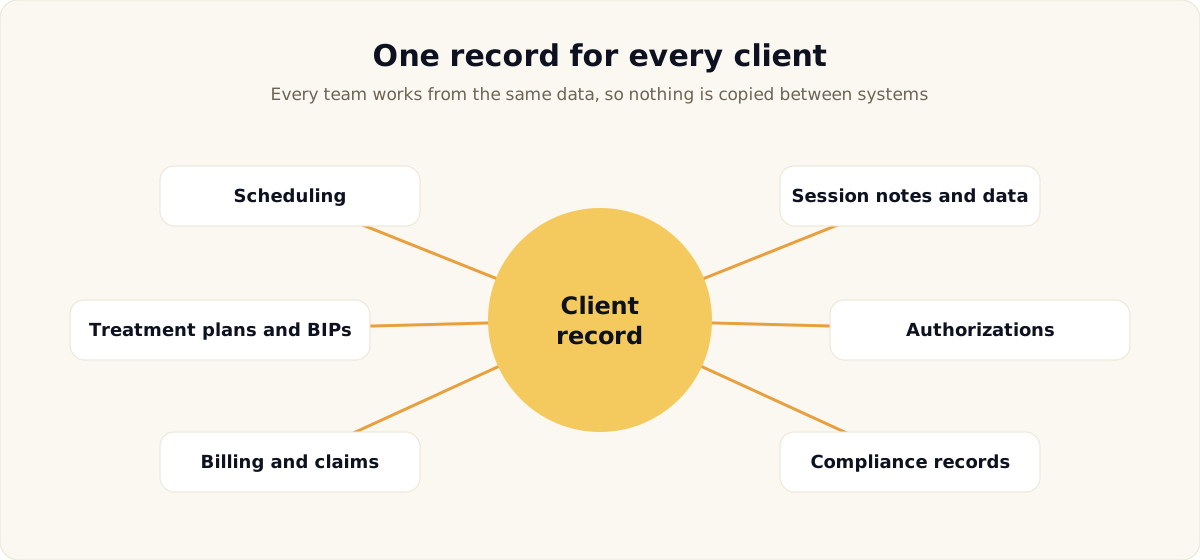
The signed note becomes the claim line, with CPT code, units and authorization taken from the same record. Rule-based checks run before the claim goes out through the built-in Stedi integration. Where Electronic Visit Verification applies, EVV is captured when the note is signed, with an exception queue and a claim gate. A guardian portal adds a check-in kiosk, secure messaging and consent signing.
See the full feature list on our ABA EHR page. To test these four workflows on a vendor demo, use our guide on how to choose an EHR for a small ABA practice.
*This article was created with AI assistance and reviewed by the Lumenality team.*